Communication Isn’t Being Disappeared — It’s Being Captured
The New Sovereigns of Intent & The Coming Regime of Authorization
Nov 14, 2025
Carter Adamson
#communications
This spring, Microsoft sunset Skype. The announcement landed like an obituary printed on page 12: perfunctory, expected, already emotionally priced in. In the years leading up, Microsoft had been slowly disassembling it for parts, folding pieces into Teams, letting the edges blur until one day the product disappeared without a wave.
My kids have never used Skype, seen Skype, or believed Skype existed — like fax machines or audio-only calls. It wasn’t an ending. It was a timestamp. The frontier had already moved.
This story repeats in communications because communications is never the product. The product is the graph — first identity, then social adjacency, then economic expression — and the platforms that endure are simply the ones annexed by human behavior.
The Identity Graph spoke in moods, tags, and away messages
I started in communications when the internet was somewhere you logged into, not a place you increasingly can’t log out of. Going online felt like borrowing the house phone — temporary, slightly illicit, and easily interrupted if you mom upstairs lifted the receiver. AIM and MSN Messenger weren’t chat apps. They were the first starlight of online presence. Status messages were press releases from your interior life — flirtation, angst, affiliation, and soundtrack. Language wasn’t conveying; it was signaling membership; it was a way to claim “my space.”
Technology didn’t invent those impulses. It just gave them better acoustics.
The Social Graph inherited adjacency, not identities
At Skype, the brilliant engineering team wasn’t waxing philosophical about emotive UI. They were wrestling physics: NAT traversal, packet loss, jitter, echo cancellation — forging global presence out of a network that was never designed for it. And socially, we were trying something that almost looks absurd in hindsight: a global communications graph with no underlying social graph at all.
AIM had a kingdom. MSN a fiefdom. Yahoo its own borders. None connected.
So we made a blunt bet: free, simple, everywhere — and let users smuggle their own networks across borders.
And they did. Ferociously.
Skype didn’t just solve free calling. It solved proximity at global scale.
Nothing taught me this faster than Skypecasts — our accidentally-released social audio prototype (a primitive Clubhouse). We expected tidy discussions. What we got was something closer to an emergent digital civilization: language circles, pirate radio DJs, underground comedy nights, guild raids, study groups, jam sessions… and exactly the amount of adult mating calls that any digital Jane Goodall would’ve confidently predicted.
Lesson learned permanently:
People don’t organize around tools. They organize around other people and shared context.
The pattern metastasized:
Xbox Live became the world’s first accidental VoIP backbone
Slack became ambient group cognition and shared execution
Zoom became a civic utility during Covid
Discord proved the atomic unit of the internet was not messages, but rooms
When I met Jason Citron in Discord’s early days, his thesis was elegantly crude:
“Skype sucked for online gaming.” He wasn’t describing a feature gap, he was describing a unit of social organization. Digital life wasn’t about transmissions. It was about persistent adjacency.
If you want to understand communications, ignore Gartner and watch teenagers assemble a Fortnite scrim. Coordination reveals the platform better than any product roadmap.
Then the graph learned to speak money
Communication didn’t just get social — it got transactional.
WePay, PayPal, Venmo, Cash App, Stripe, Apple Pay didn’t digitize currency — they vernacularized it. Payment became syntax. Money became gesture.
Venmo captions
Rent by emoji
Robux, V-Bucks, skins, gifting
Value stopped being a number exchanged and became a signal broadcast. The Social Graph didn’t swallow payments — payments became a dialect inside the social graph.
This story repeats in communications because communications is never the product. The product is the graph — first identity, then social adjacency, then economic expression — and the platforms that endure are simply the ones annexed by human behavior.
And now comes the bigger inversion.
Some insist communication will dissolve entirely — language flattening into intent, interfaces fading into intuition, agents doing the rest quietly. We’ve heard versions of this for twenty years. The interface will disappear. The system will just know.
More often, interfaces merely just relocate— somewhere less visible, less contestable, more upstream. The transition underway is not from interfaces to no interfaces. It is a transition from interfaces that respond to you to systems that act for you. Less instruction, more delegation. Fewer inputs, more authorized outcomes.
This is not minimalism. This is a jurisdictional shift. It is a relocation of agency — from individuals to the systems empowered to make decisions in their name.
This shift can be mapped plainly:
Intent → Interpretation → Authorization → Execution → Verification → Underwriting
Every future system of consequence will resolve to this chain — because communication no longer ends at understanding, it ends at liability. The question is no longer can a system reply, but is it entitled to act, and who bears the downside when it does?
Because when communication becomes action, the leverage moves to the layer that controls execution.
AI is of course only accelerating that shift.
As this shift accelerates, language becomes less like a medium and more like a handoff point. The meaningful work no longer happens in the utterance itself, but in what happens after: interpretation, planning, permission, execution, and verification. This is why the frontier has moved from chat interfaces to agent orchestration, from responses to persistence, and from generation to governance and auditing.
A concrete example of this shift is already in motion. Microsoft Research recently introduced Magentic Marketplace, an open-source simulation environment for studying multi-agent economic systems — not chats, not prompts, but markets, complete with negotiation, competition, incentives, cooperation, and failure modes. The research frames agent interaction as an economic and governance problem, built to stress-test safety, cooperation, incentive design, and emergent behavior at scale. In other words: the frontier being studied in the lab isn’t conversation. It’s coordination and consequence.
Below this, an unglamorous but decisive layer is forming. The infrastructure coordinating these systems — protocols like MCP, policy engines, authorization layers — are rapidly becoming more strategic, because this is where intent becomes sanctioned action.
If chat fades into the background, then trust itself becomes priced, measured, and underwritten. Future data rooms will no longer ask whether a startup has better models or cleaner UI. They will ask: Is this a true agentic system, or a chat wrapper in disguise? The metrics will shift from benchmarks to entitlement scopes, revocation SLAs, audit completeness, downgrade safety guarantees, and proof-of-action.
This is the rookie plumbing that lets agents discover tools, negotiate capabilities, and share context. Like SIP, STUN, and TURN for VoIP, MCP is the handshake before autonomy. Not a product, a substrate.
But as always, protocols don’t accrue power. The authorization layer does.
And this is where the “captured” thesis becomes literal. Authorization will accrue to:
Incumbents who already control identity and entitlements(Okta-class infrastructure)
Auditors for agents — the new trust layer validating scope, safety, and correctness
SMTP didn’t capture email. Google did.
SIP didn’t win VoIP. Carriers did.
MCP won’t own agency. Authority will.
The inevitable outcome is a new middleware class: Agent PCI — the Stripe for proofs.
A standard for action receipts, forensic replay, liability fencing, and incident verification. If Stripe standardized proof of payment, Agent PCI will standardize proof of sanctioned action — a category-defining moat.
Because the frontier is no longer: “Can we communicate?”
It is: “Who has the right to act on who’s behalf, with what boundaries, audit, recourse, and liability?”
Identity asked: Who are you?
Authorization asks: What can you do?
Agency asks: What can you do without asking me again?
Boards will not ask how smart your model is. They will ask:
“What are your agents allowed to do, and how fast can you revoke them?”
Permission will matter more than perplexity.
This is the new center of gravity:
Granola joins meetings, extracts decisions, commits work
FigJam agents convert feedback into live design artifacts
Altoida tracks cognition and caregiver handoffs
HippocraticAI handles patient intake, logs clinical context, and informs triage
Home agents reorder, schedule, pay, reconcile silently
Robots negotiate spatial tasks with other robots
Minimal UI. No translation layer. Less and less checksum by a human in the loop.
For twenty-five years, we built systems obsessed with identity and access — authentication and authorization as permissions: “Who are you, and what are you allowed to see?”
The next twenty-five aren’t about permissions. They’re about agency. “What can act on your behalf — without you?”
Not access control, but action control. Not identity, but delegated autonomy.
The Authorization Graph is the new identity layer
This isn’t a product. It’s a substrate — a new infrastructure layer:
Authorization Graph — The Stack
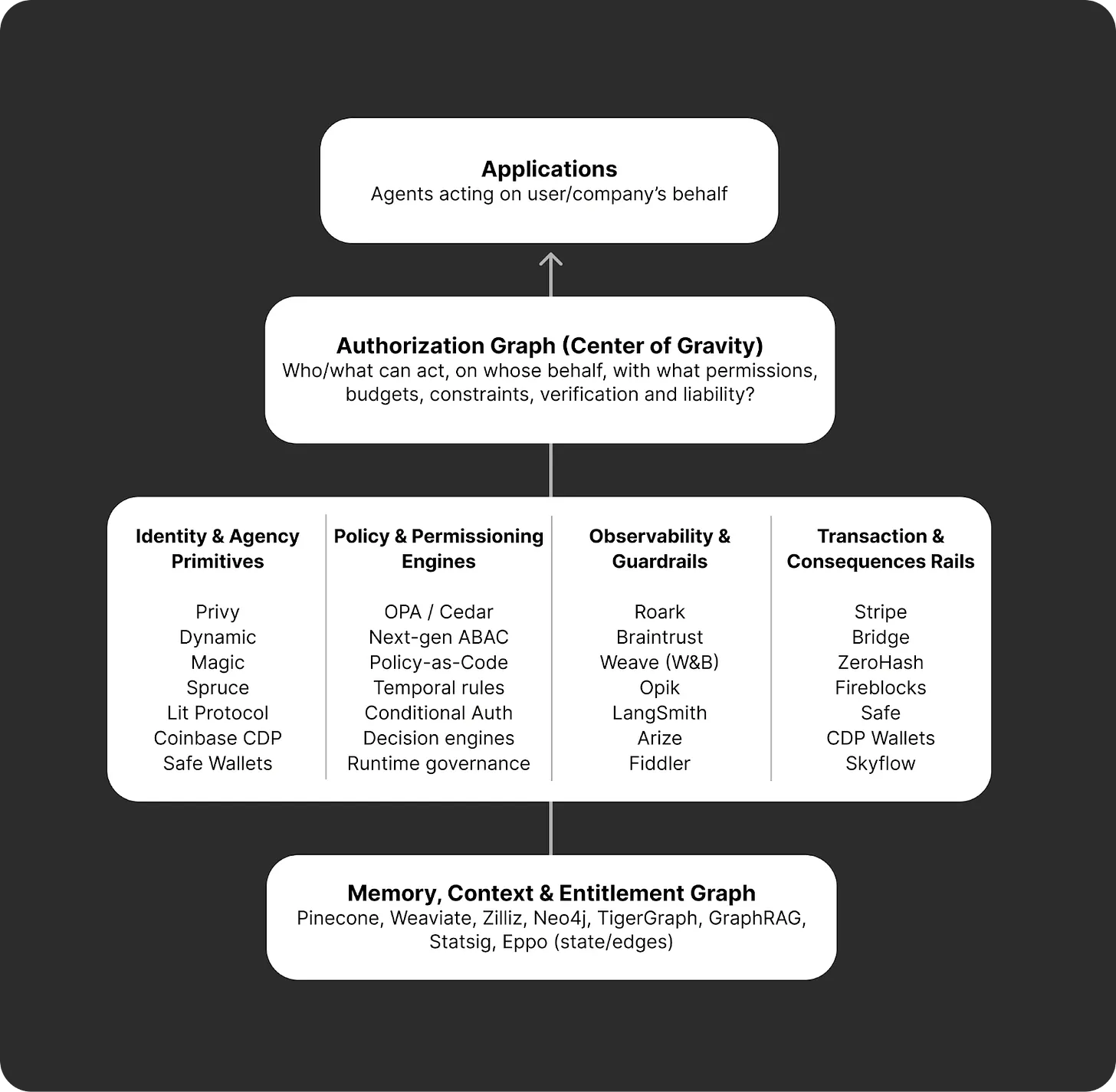
These layers matter because the consequences of agentic action vary dramatically across verticals. A medical agent can’t share a permission model with a supply chain agent. A retail shopping agent can’t govern itself like a trading agent. The grammar will be shared. The underlying protocols will be standardized, but regulation, risk tolerance, and permissions will be vertical-specific.
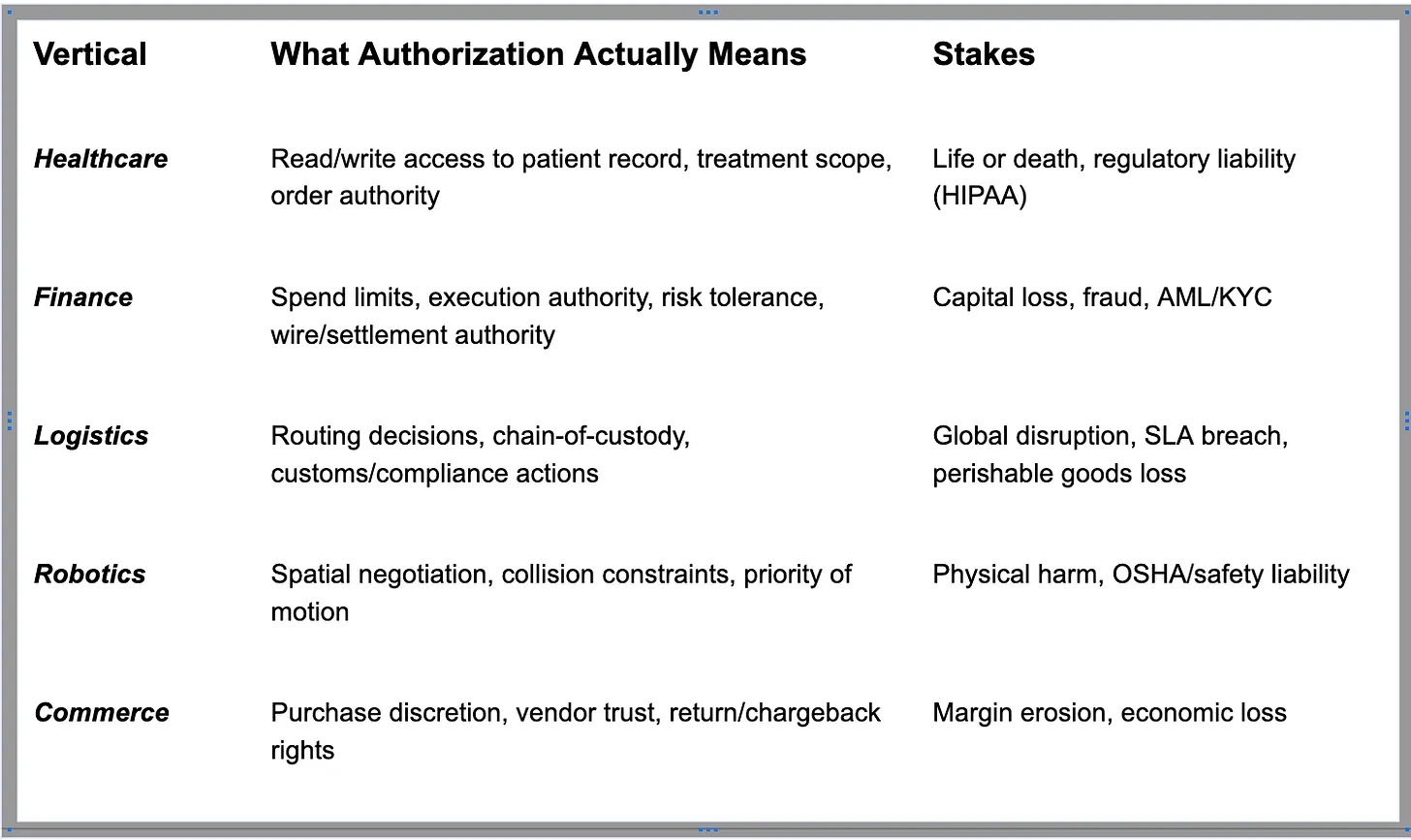
The Authorization Graph isn’t one standard — it’s a family of governed agency models with shared infrastructure but domain-specific enforcement.
The winners of the next era won’t make communication richer. They will make it less necessary. Not better chat. Less chat.
Once synthetic voices feel real, realism stops being the goal. The competitive edge shifts to correct interpretation of intent, reliable execution, and verifiable outcomes. Tone, pauses, and rhythm stop being emotional expressions — they become telemetry for understanding state and intent. Communication won’t be the product. Outcomes will.
The defining feature of the most important communication systems of the next decade will be this:
You won’t see them working. You’ll only notice when they break. No threads. No pings. No unread counts. No interfaces. Just outcomes, quietly arranged. Like DNS — utterly invisible until a site fails to resolve.
This is the Authorization Graph — the successor to the identity graph, the payments graph, and the social graph.